

Chapter 1
What does poetry tell us about humanity’s evolving consciousness?
Words denote meaning
Words in verse can give meaning life … or take it away
This course moves through the history of verse from the dawn of collective meaning-making and civilization-building to individualized expression, fragmentation, rebellion, and the dissolution of meaning altogether.
This is not simple chronology, but a map of humanity’s shifting lens through time with poetry as the key.
Let’s begin
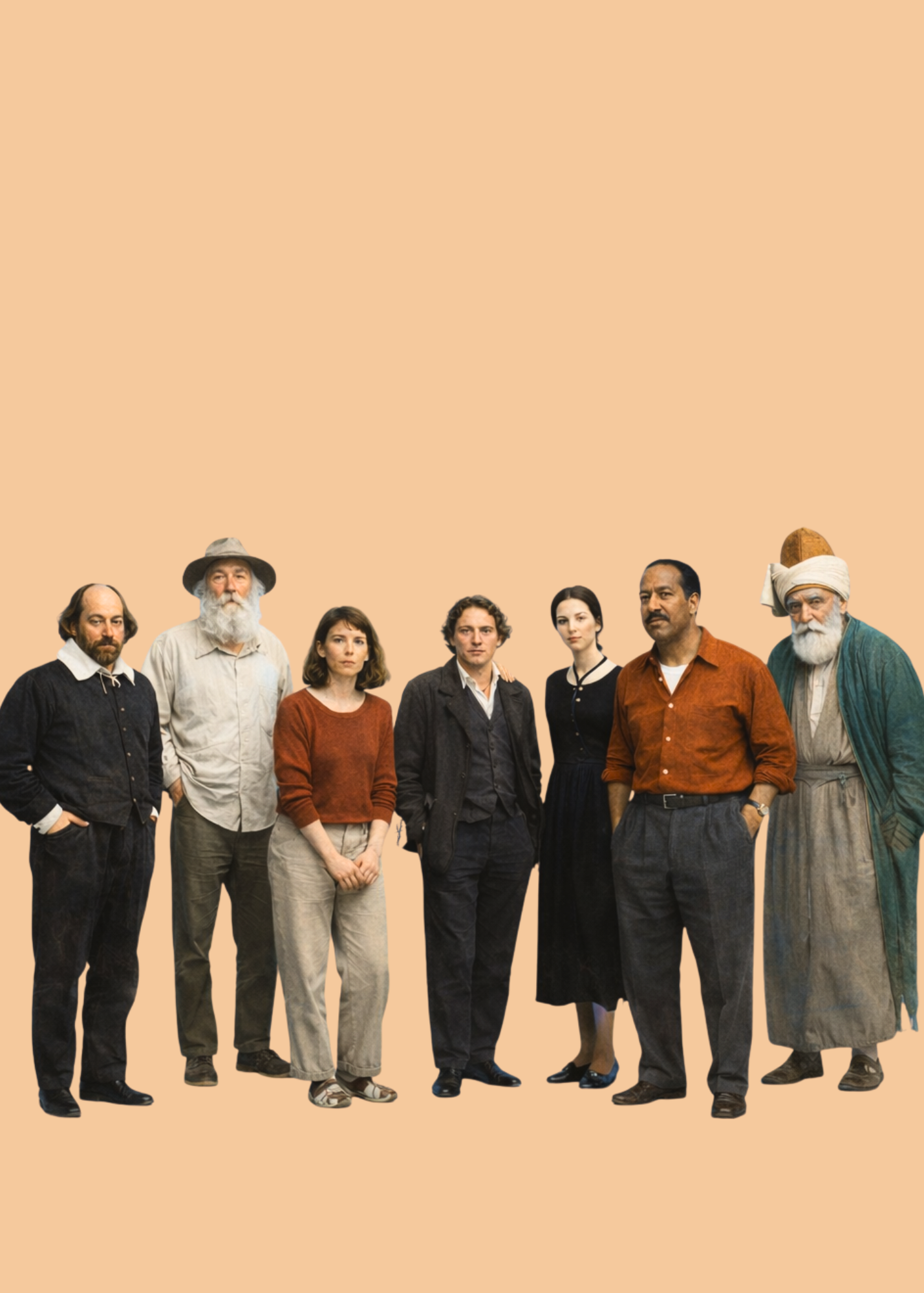
Scroll down for more
HOW IT STARTED
A great poet can convey a lifetime’s wisdom in a single line of verse
Poetry is distinct from prose in a few important ways. Generally prose writing chronologically lays out information in grammatically structured sentences. That’s what you’re reading now. This is good for systematically relaying information in a written and documented format.
Poetry first originated because before the invention of the printing press, which would make written prose available to populations, an alternative was needed for the spreading of information. To solve this problem, words were engineered into verse, condensing complex concepts into shorter adages and composing them with pleasing rhyme and repetition so they could be easily committed to memory and eagerly shared.
Think early memetic warfare but with spoken word and sound instead of image and text
Good poems were integral to holding together civilizations with laws, lineages, and moral frameworks.
Summarized: poetry was created out of the necessity for information sharing and its engineering had everything to do with memorability and memetic impact. A well-composed verse that people enjoyed reciting would spread more widely and have more staying power than a poorly composed string of purely informational lines.
Once the printing press is invented and longform text can be replicated and shared, poetry moves from civilizational necessity to individual art form and grows from there.
This course moves though the history of verse, beginning with the pre-print era and moving up to present day, zooming in on selected works based on both thematic alignment and No Hold’s leanings.
This will give you a solid foundation of understanding and hopefully a launching point from which you may orient yourself to certain schools, poets, and styles based on what sings to you, as well as bonus insight into humanity’s inner and outer evolution.
Note: This course is created by a Canadian and so has a European, North American bias in perspective. We will be delving more deeply into other nationalities later in the school’s curriculum.
A downloadable PDF will be available at the completion of the final portion of the course