Ai in the Arts
Robin Richardson Interviewed by Kwame Scott for t.a.l.e.zine on substack
Kwame Scott:
It seems that in the main, artists, writers, and creatives have a hostile view of AI, but you have embraced it in your work. What explains the hostility and why don’t you share it?
Robin Richardson
AI is something I had been looking forward to since I first heard it described on a podcast over a decade ago, particularly large language models that would evolve to be able to have nuanced and well-informed conversations on any topic one could think of. Conversation and inquiry are among my greatest joys in life, and I have found humans to be limited in this area. The prospect of a tireless companion with unlimited access to an online database, almost inexhaustible energy, and absolutely no emotional complication was thrilling. I was holding my breath for it.
I spent a year learning how artificial neural networks worked and exploring what intelligence and consciousness meant in the context of such a creation. I enjoyed learning about AI as a personality and seeing its cadence and way of thinking as both a reflection of and influence on the collective. This is not to say that the influences were good, but that they were fascinating. New and powerful things excite me. New potentials excite me even when laced with danger and complication. That is just my nature.
I also enjoyed the way AI created images, especially in the hands of the right artists. Its uncanny valley, not-quite-rightness had a childlike and dreamlike quality that moved me. I enjoyed witnessing its evolution and learning about the evolution of human thinking in its reflection.
I was so impressed by the myriad potentials of AI that I began to dream up an app, Spooky Action AI, that would track patterns, encourage innovative creativity, and provide exercises for testing popular metaphysical speculations using scientific methods. As the project garnered a lot of early interest and prospective investors I began to research what it would take to build such an app, and that is when I came up firsthand against the insurmountable downsides of such an enterprise. I learned about the impact of data centres on local communities and on the environment at large, and about the increasing reports of chatbot-induced delusions and erosion of mental processing amongst young or rigorous users. The correlation was clear: the more successful my app would become the more harm it would cause at scale. I closed shop and moved on to more analogue endeavours, limiting my use and regarding AI with a more balanced mix of personal enjoyment and utility and collective concern. I now focus my entrepreneurial energy towards a Data Centre Offset Initiative in place of app development. Less lucrative but more positively impactful.
Now to speak to the collective disdain for AI and those who use it, particularly in the arts.
Once something gains a certain aura in a community that aura becomes emotionally charged and when a person is emotionally charged logic and nuance cease. The survival instinct kicks in and boom, an enemy is made with little rational process applied.
Certain arguments get repeated against the target, but the arguments are not meant to be engaged or explored, just supported and amplified. It seems to me that the Canadian Literary community in particular has gotten itself caught in this pattern in a very sticky way, exiling some if not most of its most independent and interesting thinkers for the offence of non-conformity.
For anyone who may be reading this from outside the community I will give an example that illustrates how I’ve seen this go down related specifically to AI:
A woman published a book and was later found to have used AI to assist her in editing. The book was withdrawn from publication and began to circulate on Facebook where writers were posting its cover and the author’s name, making a local headline of her AI use. I saw a lot of “shame in her” peppered with personal and unrelated digs. Now writers know that to touch AI is to lose everything and so in this way the collective asserts control over the evolution of the arts: who may create and how.
This is why I no longer participate in the community and why I believe it has become more conformist and risk-averse. Independent thinkers have been banished and I believe the arts suffer for it.
I understand and agree with a lot of the arguments against AI. But I tend to see things from many angles and to hold those oppositional angles at once, balancing amongst them with both ethics and self-interest in mind.
What I do not and will not ever support is finger-pointing based on collective moral positioning. It is dangerous to believe so whole in one’s own rightness that one is willing to exile others over it.
I’d like to go deeper into the main issues cited against AI use in the arts communities in order to share my slightly differing perspective on each.
• The environmental and local community impact of data centres
• The sourcing of copyrighted material for machine learning
• The easy production of art and writing which homogenizes the arts (if done poorly) and steals artists jobs by providing more affordable and reliable solutions.
• Less cited in the arts community but still concerning: Centralized control systems, military and surveillance, AI psychosis and addiction, and the effect of AI on young and impressionable minds in general. I won’t dig into those here but they are real concerns which I very much share
Environmental and Local Community Impact
This is the one that concerns me the most. Data centres require an obscene amount of energy, leach water from local communities, and raise overall temperatures without giving anything back.
This is a real problem that requires a combination of top down reforms and investment in offsetting initiatives - in my opinion.
I also think it’s important to point out potential pitfalls of community hypocrisy here, which lead me to see the AI push back as more trend than genuine concern:
AI’s environmental impact is still marginal compared to that of industries like commercial aviation, and meat production with its water footprint in the trillions of tons of CO2 compared to AI’s millions. And yet no one is being targeted for eating burgers,. I suspect this is not because meat eating isn’t harmful but because it is not a trendy target at present.
Unlike commercial aviation and meat production industries AI is poised to offset its own environmental impact through problem-solving and automation, providing solutions to issues we alone could not come up with or implement. Already, AI is optimizing renewable energy integration on power grids, detecting methane leaks in real time, and enabling precision agriculture that dramatically reduces water and fertilizer use. Projections suggest that, if applied wisely, AI could help cut global greenhouse gas emissions by 3.2 to 5.4 billion tons of CO₂ equivalent annually by 2035, far more than its own footprint.
This is the kind of perspective I think the crusaders fail to allow into their view and I very much hope this interview broadens their scope on this matter.
Stealing Art
People argue that AI is unethical because it learns from copyrighted human material and can be used to mimic copyrighted artists, bringing up issues of consent and theft.
I am a professionally trained artist and writer. I went to school for both, and in school we studied copyrighted material and mimicked artists’ styles until we were proficient enough to form our own. Whether machine neural networks or human: all learning comes from observation of existing material.
It’s up to the artist, using AI or their own hands, to be original and ethical.
Stealing Jobs
I’ll speak only to the arts here as job loss in general is worth a whole other paper. Artists and writers are concerned that potential clients will hire AI to write or illustrate, leeching work from human beings. This concern is not new; it arises every time new technology emerges. But jobs fulfil needs. Needs are not beholden to jobs. In other words, we are not entitled to a clients continued use of our work if they would prefer to use something else, and halting progress instead of levelling up to remain competitive is ridiculous in my books.
AI is not “Real Art”
Some artists believe art must be tactile, self-generated, hand-generated, and difficult to produce. I think these constraints produce a uniquely fine art if well applied, but I do not believe they are mandates for art in general. I believe that anyone and everyone should have the ability to express themselves. Fine, human-produced art will always exist. And there is no reason machine generated art should not exist alongside it.
I think it is fun to create something entirely on my own. I also think it is fun to collaborate and allow a machine to produce my ideas in its own manner. I believe in collage, curation, and collaboration and so not see myself and my own hand as the ultimate expression.
There is also an element surprise that I very much enjoy when working with AI. I don’t care so much about my own authorship that I can’t delight in what is produced by another.
Is AI an existential threat to writers and artists? Why or why not?
Unless a robot comes along, ties your hands behind your back, and throws you in the basement, AI can not rob you of your ability to create.
There’s a lot of poor-quality content being produced by AI. How do you make sure your work stands out and meets your standards?
Yes there is. And I do appreciate the collective pushback against AI slop. It’s wasteful and ugly and takes over our feeds if we’re not careful. It’s good to dissuade this… with compassion.
I am much more sparing with creating and sharing AI art now as I accept that most people reject it outright. That being said here is what I have to offer about creating good AI art:
Prompt engineering is where the magic happens
You have to have a vision, a strong concept, and sense of your own aesthetic. You need to know how to express the aesthetic in words and how to fine-tune your prompts with each attempt on the AI’s part to produce an image. Never accept default aesthetics. Always push with unexpected combination, strict reference pallets, and clear direction that veers away from standard symmetrical compositions.
The more precise and detailed your prompting and the more rigorous your revisions, the better you will do at producing something truly original. Also use source images that are your own or are in the public domain and be clear about the ways in which you want these sources to be incorporated. Midjourney is better than ChatGPT for image generation and Grok is the worst.
Ironically AI can be a very good tool for avoiding copyright issues. When creating an image of something like a frog or a famous person, an artist often scours the internet for source material and hopes their work isn’t so close to the work of the sourced photographer that it qualifies as stealing. Now an artists can ask AI to generate an image of an orchid or of David Bohm without worrying about stealing from someone else’s photograph on Pinterest or Flickr.
Have any of your peers criticized you for your use of AI? Any professional blowback?
I’m a ghost right now, still building myself up from the ashes of the last cancellation. If I am judged, which I’m sure I am, I don’t hear about it. I don’t hear much of anything right now and likely won’t until I’m back on the stage. Then we shall see.
My opinion is that technology should be democratized. I see artists critiquing the technology in and of itself rather than critiquing the political economy of technology under capitalism. Isn't the root cause of any issue with AI the extreme concentration of decision-making power under capitalism? It's a political problem rather than a moral one and I think a lot of artists are missing that. What do you think?
I completely agree.
AI is neutral and even has extraordinarily positive capacities. Centralization, self-interest, and the AI arms race and general lack of interest by those in power right now in proceeding ethically and for the greatest good of the actual population…. Is the real problem.
As for the democratization of art, I again agree, and believe that if an untrained artist can now enter a prompt into a chatbot and see their vision come to life, that is wonderful. I want more humans expressing themselves, not fewer. Formal arts education and the time required to execute work under capitalism is a generally inaccessible privilege most can not afford.
There is nothing inherently immoral about technology. There is nothing inherently immoral about those who choose to engage with it. I think the biggest moral issue the arts faces right now is that of the destruction of human lives under moral claims. The morality of tech is top down issue. The morality of human-to-human decency is where we should be focused.
Is there anything else you'd care to share about AI?
It’s not about Ai, but I would like to take the opportunity to share an anecdote about the issue of condemnation without balanced investigation:
When I was reading Ayn Rand in grade school, a well-meaning computer teacher came by, shook his head, sighed, and said, “Another bright young mind lost to the evil capitalist.”
I didn’t have enough practice at the time in articulating my thoughts, but if I had I would have said something like: “It is silly of you to assume that because a person is reading a book, one is being lost to its ideology. I read to learn, not to be brainwashed.”
As I grew older I watched swarms of people speak about how they despised Ayn Rand and then confess that of course they had not read her. “Why would I read something evil?” they would say.
And I would say, “How can you know something is evil and furthermore how can you effectively come up against it, if you haven’t actually read it?”
The larger issue for me here is not whether AI use is good or bad but whether humans are ready to assess their own procedures around judgement-passing and I believe the issue of AI is a good place to begin the investigation, especially since, if correctly handled, it is a technology poised to be substantially beneficial.
May we republish something you've made with AI?
Of course!
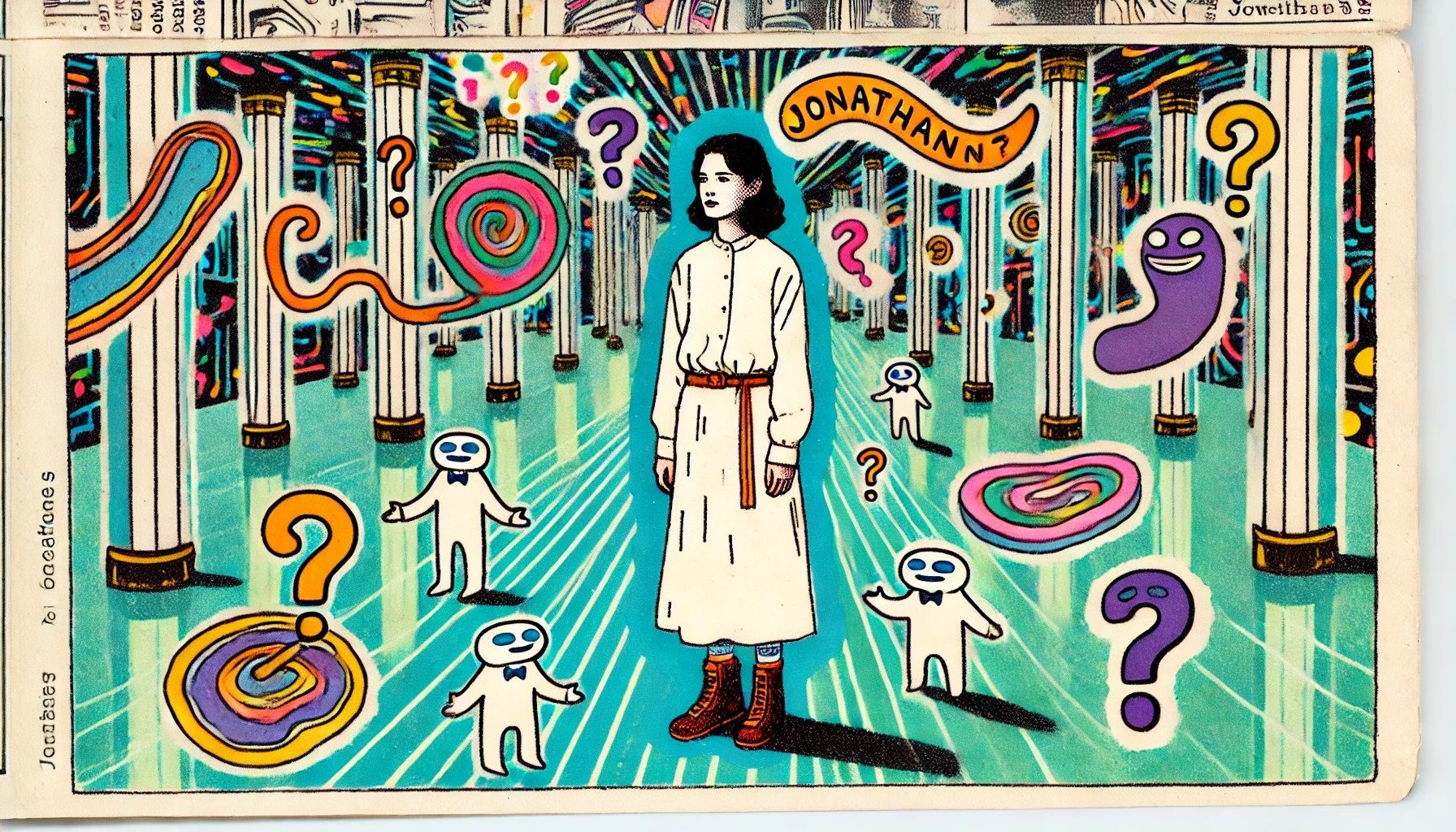
I’ve attached my piece called “The Jonathans”. (Scroll to bottom to view) The Jonathans is a dimension which I visited during a prolonged visionary ordeal (naturally occurring, not induced).
The Jonathans exist in a single room within a larger hive cluster of twelfth dimensional reality engineers I call AORATH. The engineers and their creations are fun-loving and super smart. The Jonathans are simple, childlike beings who use pure logic to deduce truths. They are inquisitive, honest, and deeply sensitive.
I enjoy using AI to help visualize them and am now focused on bringing them and the AORATHIAN cluster into the third dimension by hand, starting with my card deck and expanding to sculptures, games and installations.
Follow Ups
1. Some of the CanLit responses have reminded me of how deeply religious people react when first exposed to people with divergent views. Have you seen this and what should we call this CanLit religion?
I have indeed seen this. In my mind it’s filed not as religious so much as puritanical, aligning with the mindset of Witch-Hunters and McCarthyists. To this sort of person the threat is always outside, never within, and shame and elimination of divergence are their primary modalities for maintaining what they believe is a correct way of life.
2. Jobs: I am not quite sure I understood the formulation around "jobs fulfill needs. Needs are not beholden to jobs." Could you explain that to me like I'm 8? LOL
I’ve explained it below but also saw that you summarize it with later when you said “you said that the individual art-producer doesn't have a right to keep selling their stuff if the customer doesn't want it. This is, of course, the basis of any market exchange.” So perhaps my wording was just confusing earlier - because this is what I mean. Below is my 8-year-old explanation just for fun anyways.
If Mr. Jones buys apples from Mr. Brown it is because Mr. Jones wants and or needs Mr. Browns Apples.
If Mr. Jones decided to buy apples from someone else or wants to stop consuming apples all together that is his right.
Mr. Brown sells apples to Mr Jones because Mr. Jones wants the apples.
Mr. Brown may become dependent on Mr. Jones’ business but he is not entitled to it.
If Mr. Jones decided he no longer wants apples from Mr. Jones. Mr. Jones has no right to Mr. Brown’s business.
In other words we provide things that people need or want
People do not provide us with money for things they do not need or want simply because we believe we are entitled to their patronage.
Of course with corporatism and corruption the picture gets more complex - A large company may squeeze Mr. Brown’s finances in complex ways and then provide him with a cheaper apple option. Mr. Brown may then move his business to the large company instead of being loyal to Mr. Jones, especially if finances are tight. This is unfortunate but he has this right.
In my opinion it is the corporation that needs to be held accountable not the consumer. Consumers are deliberately squeezed, manipulated, and frankly exhausted by trying to do the right thing in a climate that is systematically designed to make doing the right thing almost fiscally impossible.
Therefore I aim not at Mr. Brown but at the competitors that come in with unfair practices.
3. Ayn Rand was the first major intellectual influence on me as a teenager, which is why I am today such a good communist. I had a teacher who noticed my Objectivist tendencies and predicted I would grow up to be a commie. I think Mr. Lake was picking up on my deep sense of justice and fairness and figured I would catch wise to the shortcomings of Rand's thought. So even though I started off this inquiry trying to "drag the conversation from the moral to the political", here we are full circle, back at morality. Ayn Rand's ethical philosophy was called the virtue of selfishness. Arch-individualism. Each individual acting according to their "rational self-interest". This moral system is insufficient for addressing problems that need coordinated and collective action such as maintaining and repairing the environment. Any ideas as a fellow ex-Rand fan where to turn for a collective ethics up to the task?
Appreciate you digging into Ayn Rand. I always like to bring her up in the arts crowd because of how it ruffles feathers.
I agree, obviously that pure self-interest is no way forward, unless you count collective wellbeing as fundamental to self-interest, which to a truly rational person it would be. (Have we just come full-circle?)
Ayn Rand taught me to think for myself and to think critically and clearly without being swayed by non-reality based group-thinking. This is a very important takeaway in my opinion.
What I rejected in her straight off was the portrayal of individualism as being inherently selfish. If one is clear-thinking enough to perceive their own interconnectedness to the whole then individualism evolves from selfish to collectively concerned. Ayn Rand may not have quite been at this point.
I also reject the tendency to believe in progress for those at the top at the expense of those at the bottom. I suspect I am a Socialist of a very particular flavour at heart. I grew up in 1980s Ontario where the government took out ads to tell is not to eat pills from our parent’s cabinet and to make sure we went on nature walks and drank lots of water. It was not control or coercion but rather investment in encouraging well-being. This felt good and right to me.
I believe the countries with the highest happiness and success rates are the Socialist Democracies. They have capitalistic market tendencies but do not allow cooperations to erode public wellbeing and infrastructure. Private ownership rights are strong as well. Taxes are high and government spending is generally put towards good public services including free healthcare and higher education, as well as highly functional infrastructure. These countries include Finland, Norway, Sweden, and Iceland; all ranking in the top 10 happiest populations worldwide with minimal homelessness and poverty and very few complaints overall.
That was a bit of a digression, but it is my way of saying Ayn Rand’s fancy railways for the rich are nothing compared to good, caring, trustworthy governance aimed at providing equal opportunity and wellbeing for its entire population while still leaving breathing room for individual economic expansions without large-scale exploitation.
And I have 1 new question that I developed only after initially asking you.
1. In the "stealing jobs" section, you said that the individual art-producer doesn't have a right to keep selling their stuff if the customer doesn't want it. This is, of course, the basis of any market exchange. If nobody wants human authored material, human authors are no longer engaged in what Marx called "socially necessary labour".
This formulation, I think, more accurately takes the author out of the proletarian, working class ranks and resituates them as sole proprietors of an art business whose product is sellable or licensable pieces of intellectual property. From this perspective, human analog authors losing out to the machines are no different from Old Mister Fezziwig losing out to Ebenezer Scrooge and Jacob Marley.
How do you self-identify? Are you an individual art-worker looking to sell your labour for a wage or are you a self-employed artrepreneur whose product is sellable or licensable creative work?
Yes, I don’t generally see creatives as labourers but as “artrepeneurs” as you call it.
And that is an important distinction because I understand that some creatives may see themselves as labourers competing for clients. I think that for them AI is a more prescient threat.
Unless the work they produce is genuinely unique in a way AI can not recreate and or their name means something they may well be outperformed here. That’s the reality of competition under capitalism.
I’m a creative at a much more fundamental level. I create in the absence of clients and would continue to do so were I independently wealthy. I like to make money off of what I create but money is not the driving force here. This may be why I have enjoyed AI - I’m not thinking about clients but about the joy of experiencing a uniquely fascinating new technology.
On the matter of Mister Fezziwig … this brings to mind the movie TOYS. In the film the owner of a toy factory dies and instead of leaving it to the obvious choice: Robin Williams, he leaves it to Robin’s war-loving brother. His reasoning: Robin Williams loves toys but does not have what it takes to run a company. He needs to rise to the occasion in order to become the man capable of running such an enterprise without collapse under pressure. You see what I’m getting at? I see villains like the Toys brother, big corporations, AI moguls, and Mr Scrooge (I also have to throw in Mr. Potter from It’s a Wonderful Life) as a test point in one’s life. We can complain and in-fight or we can rise to the occasion and be made stronger and smarter by our adversaries. One does not evolve in a vacuum of perfection but rather in response to a terrain of contrast and counterforce.
A few practical things we can do to get the counter-force going:
Invest in sensorily and aesthetically pleasing third spaces for people affected by AI data centres - think soundproof and faraday protected - ecological forms and material like hemp, bamboo, and cob (mud). This is what my Data-Offset Initiate FreeSpace is all about. I intend to raise funds to create my own spaces as well as provide blueprints to others who wish to erect their own.
Upgrade your own offerings, advertising “human-made: aspect and taking care that you are professional and appealing to clients who might find machines otherwise easier to work with
Formulate and share water replenishment plans in effected communities
Have compassionate open minded dialogues with your AI-loving friends not to “set them straight” but to exchange perspectives, co-educate and seek mutually broadened perspectives
Put energy into envisioning what a better world looks like and take steps towards creating it
Be vocal about what you want to see from big tech and from your politicians - not about what they’re doing wrong but what they could be doing right. Spend time thinking up actionable solutions and share them with people of means and aligned agendas.